
WHY
"ROLLE"
We get that a lot.
WE NEEDED A NAME THAT MEANT SOMETHING. ABOUT FAIRNESS, BALANCE, AND THE MATH BEHIND TRUST.
The Struggle
Every startup needs a name, and every founder hates the process of picking one. You open a blank document. You brainstorm. You mash words together. You check if the domain is taken. It is. You try again.1. You open a blank document. You brainstorm. You mash words together. You check if the
We knew what we wanted to build: a platform for the entire second-hand ecosystem that makes buying used electronics fair, transparent, and effortless. A place where the buyer isn't guessing and the seller isn't gaming. We knew the what. We just didn't have the word.
The tech startup naming playbook didn't help. Drop a vowel? Tried that. Add an "ly"? Depressing. Misspelled real word? Disrespectful to both language and ourselves. You hate yourself a little.2
What we needed was a name that said something. Not just a name that sounded good, but a name that meant something. Something about fairness, about balance, about the math behind trust.
And then one of us remembered a theorem from school.
THE GIG
Michel Rolle was a 17th-century French mathematician. Son of a shopkeeper. Self-taught.3No formal education, no prestigious backing, just a stubborn conviction that he could figure things out on his own.
In 1691, he published a theorem, a structural guarantee of balance, that would later become foundational to calculus. We liked that. It's elegantly simple, and it goes like this:
THE THEOREM
HOW IT WORKS
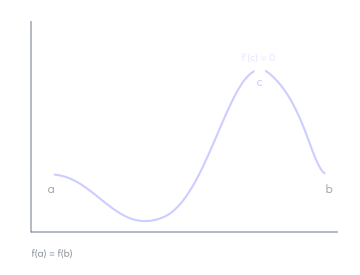
If you have a smooth, unbroken curve that starts and ends at the same height, then somewhere between those two points, there must be a moment where the curve flattens out.A point of perfect balance.A flat point. An equilibrium.
Think of it like a hill between two valleys. If you start and end at the same elevation, you must pass through a peak, or a flat point, along the way. The theorem doesn't just suggest this.It guarantees it.
If f is continuous on [a, b], differentiable on (a, b), and f(a) = f(b), then there exists a c in (a, b) such that f'(c) = 0.
The conditions are straightforward: the function must be continuous (no breaks), differentiable (no sharp corners), and its endpoints must be equal. When those conditions hold, the existence of the equilibrium point isn't a hope.It's a mathematical certainty.
Why does this matter? Because it's a proof that equilibrium isn't a fantasy. Given the right conditions, balance is a mathematical certainty.
THE CONNECTION
Now replace “curve” with “second-hand” and "function" with "transaction". In every second-hand deal, there are two points: what the buyer wants to pay and what the seller wants to earn. Two positions. Two values. Often miles apart. But there should be a fair value in between. Always.
The old way second-hand market is not continuous. Retailers, marketplaces like Facebook Marketplace, eBay, or that one guy on a forum throws you into this gap with zero visibility. Fragmented across platforms. No verified data. No real seller history. No sense of what a fair price actually is.4You're walking a path in the dark and hoping you don't fall off.
The curve is broken. When information is inconsistent, equilibrium isn’t guaranteed.
Rolle's theorem says: if the conditions are right, if the function is continuous and unbroken, then a point of equilibrium must exist between those two values. It's not a hope. It's a guarantee.
OUR JOB IS TO CREATE THOSE CONDITIONS
THE ALGORITHM
This isn't just a metaphor. Our pricing engine is the theorem, made literal. Every curated listing begins with two anchor points: the highest credible market price and the lowest. Two endpoints. Two values, exactly like f(a) and f(b). The algorithm then builds the continuous function between them: aggregating verified comps, weighting by condition, recency, and source reliability, filling gaps where data is sparse.
The Fair Price it outputs is the c where f '(c) = 0: the point of equilibrium where the curve flattens and neither side is overpaying or underselling. The gap-aware fill distributes reference points along the curve so the function stays smooth and unbroken. No discontinuities. No information asymmetry. Just a continuous, differentiable surface from buyer to seller, with a guaranteed fair point in between.
HOW IT WORKS
The "continuous function" in our world is trust. When you can verify a listing, score a seller, see the real market price, and know your purchase is protected, the curve doesn't break. And when the curve doesn't break, fairness isn't optional. It's inevitable.

That's the chain. That's the theorem. That's Rolle5.
THE IRONY
Here's the part we love most. Michel Rolle actually opposed calculus. He called it a "collection of ingenious fallacies." He thought the whole enterprise was flawed.6.
And yet, his theorem, the one named after him, became one of the foundational pillars of the very field he rejected. The Mean Value Theorem, which underpins most of modern calculus, is a direct descendant of Rolle's work.
Sometimes the outsider builds the thing that changes the system from within. A shopkeeper's son who taught himself mathematics. A critic of the establishment whose work became essential to it. A man who fought the status quo and, in doing so, created something the status quo couldn't exist without.
WE RELATE TO THAT.
Rolle team7WHY ROLLE
The second-hand market is broken. Not because people are bad, but because the system incentivises opacity, rewards information asymmetry, and punishes the person who can't tell a good deal from a bad one. We named our company after a mathematical proof that equilibrium exists. That when conditions are right, fairness isn't just possible, it's guaranteed. Our job is to create those conditions. To make the function continuous. To build the trust layer that lets the theorem hold.
Because if a self-taught mathematician from 1691 could prove that balance is inevitable given the right setup, then maybe, just maybe, a small team from Athens can prove it too.
Second-hand, don't second-guess8.
Because equilibrium shouldn't require a leap of faith.
Used. Refurbished. Everything in between.